Teaching in Social Work by Jeane Anastas
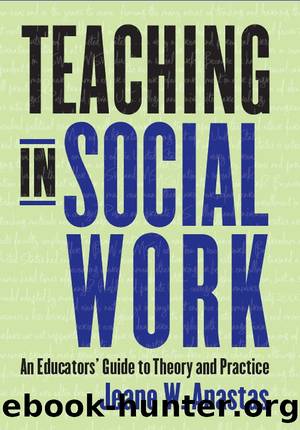
Author:Jeane Anastas [Anastas, Jeane]
Language: eng
Format: epub
Tags: Nonfiction, Social & Cultural Studies, Social Science, Human Services, Social Work
ISBN: 9780231520935
Goodreads: 58493012
Publisher: Columbia University Press
Published: 2010-04-22T04:00:00+00:00
LICENSING
Over the past twenty-five years, state-based methods of licensing or credentialing social workers, at least at the MSW level, have become universal throughout the United States. All licensing systems have at their core the mission of protecting the public by setting minimum standards for professional practice. Hence, âpass ratesâ on state licensing examinations have become another standard measure of outcome for masterâs and baccalaureate programs in jurisdictions that require licensing at that level. The Association of Social Work Boards (ASWB, http://www.aswb.org/) represents all statesâ regulatory bodies and is a good source of information about the examinations and other requirements for licensing.
While the topic of the range of credentials that exist and/or should exist for social work professionals is beyond the scope of this chapter, before discussing assessments of teaching and learning within social work education, I should note that through state legislation, society now exercises some control over who can practice professional social work, has defined the nature and scope of social work practice, and can discipline social workers found to have violated ethical or other standards of practice in order to protect those they serve and the general public interest. As in higher education, the licensing bodies themselves cannot assume that having certain structures or processes in place, like carefully crafted examinations or licensing boards adequately financed and staffed, automatically ensures that the goals of the licensingârequiring minimum standards of competence in social work practiceâare being achieved.
There are some inevitable tensions between the licensing system and educational programs. Because MSW programs use graduatesâ pass rates on licensing examinations as an outcome measure, they assume that the adequate preparation of students for licensing examinations is a legitimate service to students and graduates. Academic institutions also, however, have the sole legal and moral authority to determine curriculum content and degree requirements in all disciplines and professions and hence do not allow licensing examinations to determine the curriculum. To ignore them entirely, however, risks ignoring what others in society believe is relevant to professional practice. The relationships between the legal regulation of practice and the assessment of social work educational programs and how both are (or are not) relevant to what defines social work practice require more study.
Download
This site does not store any files on its server. We only index and link to content provided by other sites. Please contact the content providers to delete copyright contents if any and email us, we'll remove relevant links or contents immediately.
| Anthropology | Archaeology |
| Philosophy | Politics & Government |
| Social Sciences | Sociology |
| Women's Studies |
The Secret History by Donna Tartt(19090)
The Social Justice Warrior Handbook by Lisa De Pasquale(12190)
Thirteen Reasons Why by Jay Asher(8912)
This Is How You Lose Her by Junot Diaz(6887)
Weapons of Math Destruction by Cathy O'Neil(6281)
Zero to One by Peter Thiel(5802)
Beartown by Fredrik Backman(5755)
The Myth of the Strong Leader by Archie Brown(5508)
The Fire Next Time by James Baldwin(5446)
How Democracies Die by Steven Levitsky & Daniel Ziblatt(5219)
Promise Me, Dad by Joe Biden(5153)
Stone's Rules by Roger Stone(5088)
A Higher Loyalty: Truth, Lies, and Leadership by James Comey(4964)
100 Deadly Skills by Clint Emerson(4926)
Rise and Kill First by Ronen Bergman(4789)
Secrecy World by Jake Bernstein(4753)
The David Icke Guide to the Global Conspiracy (and how to end it) by David Icke(4720)
The Farm by Tom Rob Smith(4514)
The Doomsday Machine by Daniel Ellsberg(4490)
